
Designing Digital Transformation for Strategic Impact
How System Design Aligns People, Process, and Technology to Deliver Business Value

In today’s rapidly evolving business landscape, digital transformation is no longer a choice—it’s a necessity. Yet, successful transformation goes beyond adopting new technologies; it requires rethinking how organizations operate, deliver value, and adapt to change. At the heart of this journey lies system design—a strategic discipline that ensures all components of the enterprise work together seamlessly to achieve meaningful outcomes.
What is Design?
Design is the intentional process of creating or modifying objects, systems, or processes to achieve specific goals. It goes beyond aesthetics to encompass functionality, user experience, and problem-solving.
In the context of digital transformation (DX), design becomes a strategic activity — one that shapes how businesses evolve through technology. At its core, digital transformation is not about implementing new tools, but about reimagining business models, customer experiences, and operational processes to thrive in the digital era.
What is System Design?
System design is the process of defining the architecture, components, modules, interfaces, and overall structure of a system to meet specific requirements and goals. It serves as a blueprint that outlines how various elements interact to deliver the intended functionality, performance, and reliability.
In digital transformation, system design plays a foundational role by shaping how organizations integrate emerging technologies, redesign business processes, and deliver value to users. It involves architecting the interactions between people, processes, and technology to ensure they function cohesively in pursuit of strategic goals.
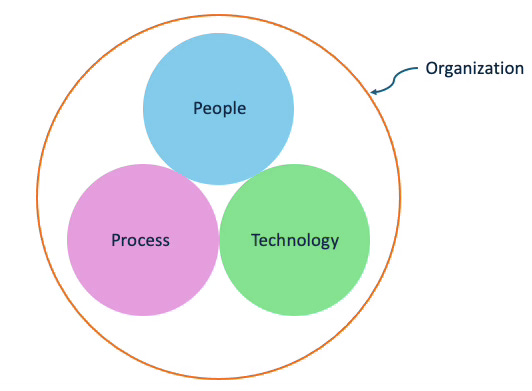
As organizations evolve in a fast-changing environment, system design helps align technological capabilities with business objectives, enabling scalable, resilient, and user-centric digital solutions.
Critical Success Factors for Digital Transformation
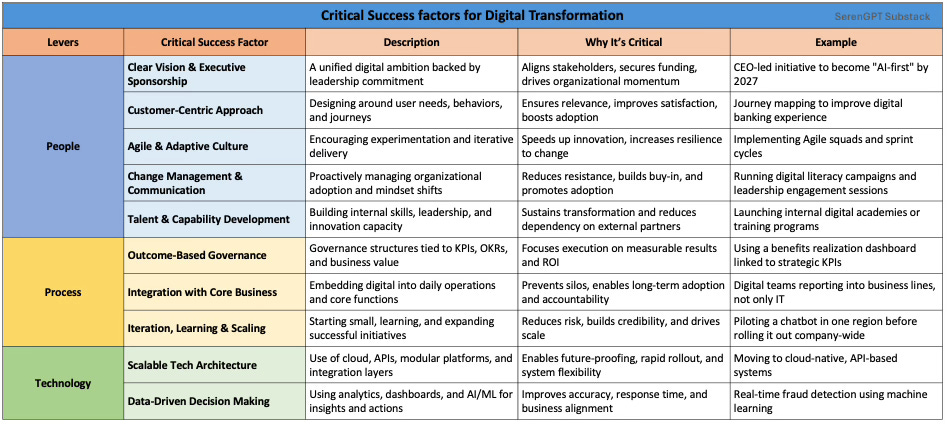
Digital transformation (DX) is complex, often cross-functional, and strategic in nature. Its success depends on a combination of people, processes, technology, and governance. Below are the critical success factors (CSFs) that consistently determine whether a digital transformation initiative achieves its intended impact.
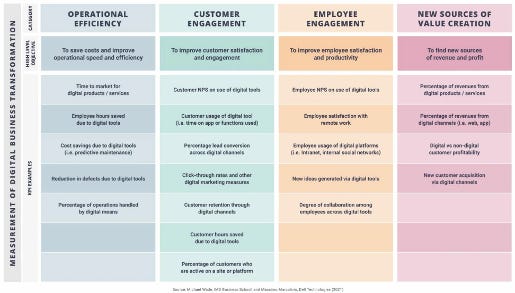
How to set goals, measure and track benefits of Digital transformation?
A structured framework for measuring the impact of digital transformation across four key value dimensions: operational efficiency, customer engagement, employee engagement, and new value creation can be used. A successful transformation requires not just system design, but also clear KPIs to track value realization and continuous improvement.
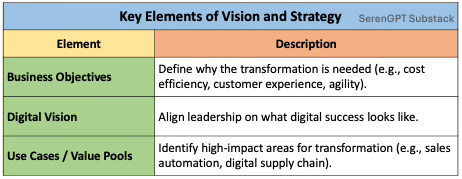
Vision & Strategy Definition
The starting point of any digital transformation design is a clear and aligned vision that sets the direction, ambition, and business justification for change. This foundational phase defines the purpose of transformation, aligns leadership around a shared objective, mobilizes investment, and establishes the strategic guidance for all subsequent design and implementation decisions.
Value Measurement & Continuous Improvement
This phase represents the closing loop in the transformation lifecycle—where the focus shifts to ensuring that the envisioned value is not only realized but also continuously tracked and optimized.
Designing for transformation doesn’t end at implementation; it requires ongoing measurement, validation, and refinement to confirm that intended outcomes are achieved while fostering a learning culture where digital capabilities evolve and scale over time.
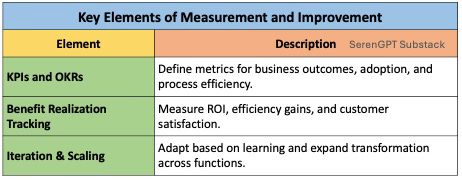
This final phase establishes a feedback loop, ensuring that the transformation remains dynamic, responsive, and scalable — and evolves as the business environment and customer expectations change.
Designing a digital transformation is not a one-time technical implementation, it's a structured, strategic journey. It starts with defining a clear vision and aligning it with business goals. It continues by translating that vision into integrated systems through deliberate system design. And it culminates in tracking and optimizing the value delivered through these changes.
At every step, system design acts as the backbone, ensuring the transformation is not just digital, but meaningful, measurable, and sustainable.